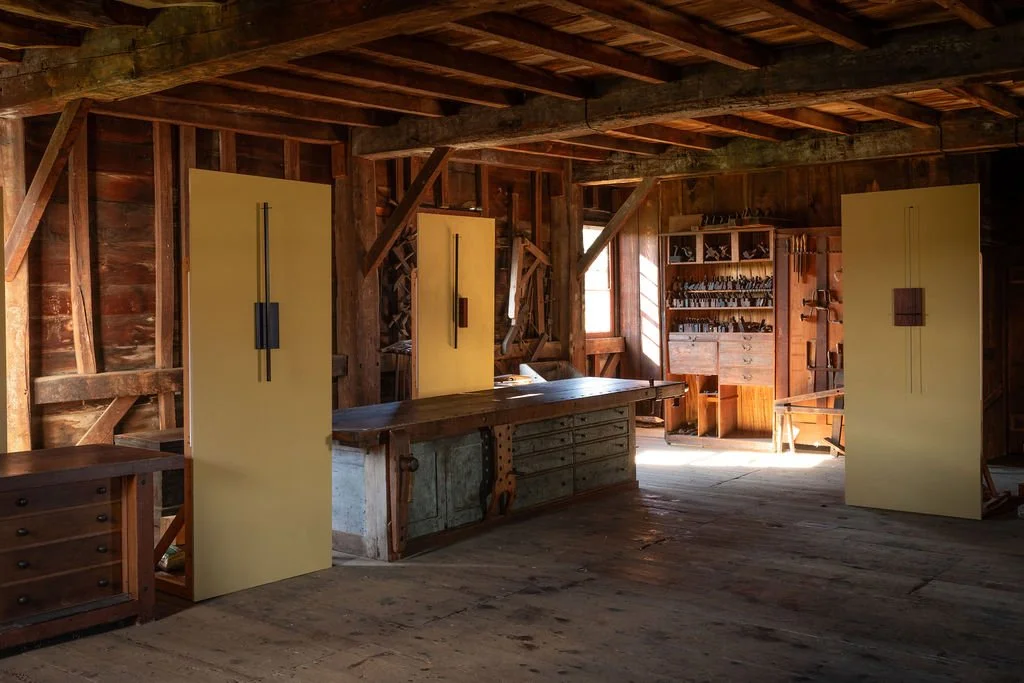
Chaste, Hancock Shaker Village
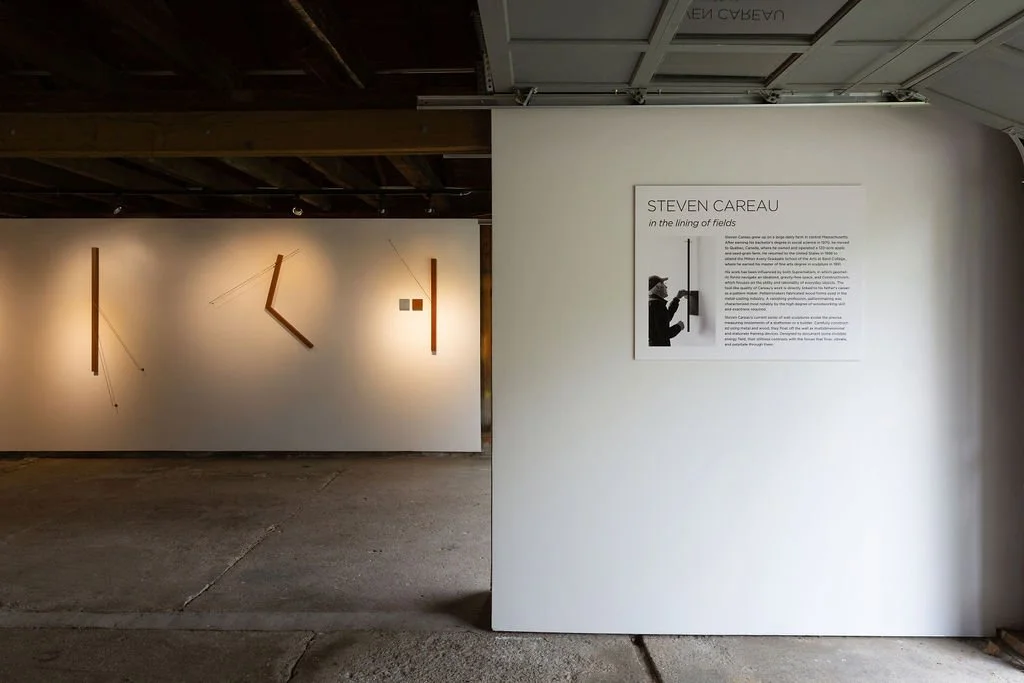
in the lining of fields, TurnPark Art Space
Balances and Measures, Columbia-Greene Community College
Suprematism, with its reductive, geometric style, has been very seductive to me. There is a sense of religiosity to it, an icon-like quality, and definite spiritual connotations. The work of Kazimir Malevich in particular speaks to me. The scholar Maria Taroutina has written that Malevich intended his Black Square to replace the fundamental belief system of the culture by creating a movement that would supplant Christianity. I see each of my sculptures as an icon, imbued with a sense of spirituality.
With Malevich you’re given this ideal space, a metaphysical realm, a space that can’t be experienced through our ordinary senses. His work exists in an idealized, extrasensory place. Malevich’s rival Vladimir Tatlin, on the other hand, stayed firmly within the physical world. These two men, in their rivalry, showed the viewer the two ways we experience the world—physically, through the senses, and conceptually, with the mind. Building on Tatlin’s work, Constructivism focused on utility and rationality. In a way, my work shows the influence of both Suprematism and Constructivism. The pieces have a tool-like or device-like quality, but to what purpose? How are they used? What might they measure? It’s a strange marriage of influences—mysticism and utility.
Many of these pieces can be adjusted or reconfigured to suit different contexts or states of mind. They each allow for uncertainty and variability. The pieces seek an answer, but they are really icons of uncertainty.
—Steven Careau
Icons and Instruments, Merrimack College